The Nonstick Revolution and Its Chemical Cost
For decades, the nonstick frying pan has been the ultimate symbol of kitchen convenience. It promised a world where eggs slid effortlessly from the pan and cleanup was a matter of a quick wipe. However, the technology that made this “miracle” possible—Polytetrafluoroethylene (PTFE), more commonly known by the brand name Teflon—belongs to the massive family of “forever chemicals” (PFAS). As the scientific consensus on the health risks of these substances has grown, many home cooks are looking at their kitchen cabinets with a new level of concern. Are your pans leaking indestructible chemicals into your family’s meals? And if so, how can you tell for sure? To understand why these pans are such a focus for researchers, one must first explore what are pfas at a foundational level.
The core of the issue is chemical stability. PFAS were designed to be both “oleophobic” (oil-repelling) and “hydrophobic” (water-repelling). While this makes them ideal for preventing food from sticking, it also means they are incredibly difficult for the body to process if they are ingested. If you have an older nonstick pan—especially one manufactured before 2015—it almost certainly contains PFOA, a long-chain PFAS chemical that has been linked to numerous health issues. Identifying pfas in products like legacy cookware is the first step in a broader household detoxification. According to the FDA, managing the temperature and condition of nonstick cookware is essential for minimizing health exposure in the kitchen.
Visual Clues: Scratches, Flaking, and Discoloration
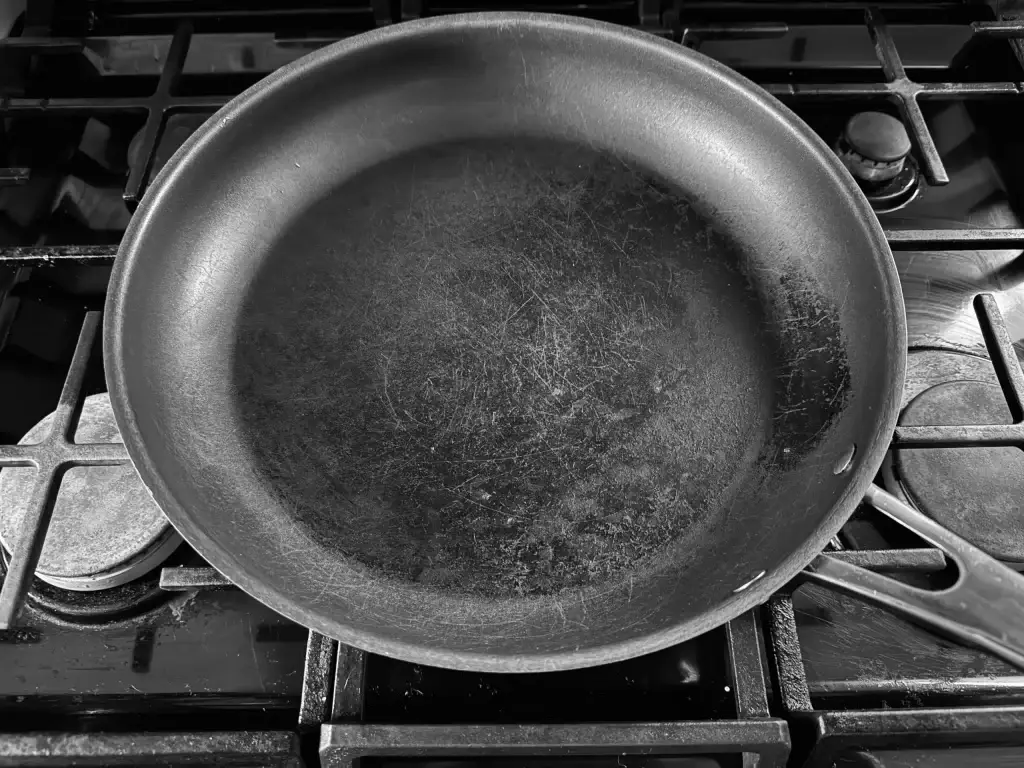
The most direct way to tell if your pan is a risk is to inspect its physical condition. PFAS-based nonstick coatings are essentially a plastic film bonded to the metal of the pan. Over time, this film begins to break down. If you see any visible scratches, particularly deep ones that reveal the metal underneath, the integrity of the chemical coating has been compromised. Every time you cook in a scratched pan, tiny microscopic flakes of the nonstick coating can enter your food. While the industry often argues that these inert flakes pass through the body safely, newer research suggests that they can contribute to the “body burden” of total fluorine. If your pan is flaking or shows signs of significant discoloration, it is time to retire it. Identifying where pfas come from in your daily meals often leads back to that one favorite, well-worn pan.
Furthermore, heat is the enemy of nonstick safety. When a PTFE-coated pan is heated above 500 degrees Fahrenheit (which can happen in just a few minutes on a high-heat burner), the chemical bonds can begin to break down, releasing toxic fumes into the air. This process, known as “thermal degradation,” can cause flu-like symptoms in humans and is famously lethal to pet birds. This is another reason why reducing pfas at home starts with a critical evaluation of your cooking habits and tools. Experts at the NIEHS are continuously studying the long-term impact of low-level chronic ingestion of these degraded chemical particles.
Decoding Labels: “PFOA-Free” vs. “PFAS-Free”
If you are shopping for new cookware, the labels can be notoriously confusing. Many brands now proudly proclaim that they are “PFOA-Free.” While this sounds good, it is often a half-truth. Because PFOA was phased out of manufacturing years ago, almost all modern nonstick pans are PFOA-free. However, many still use other members of the PFAS family (like GenX or other short-chain variants) to achieve their nonstick properties. To truly avoid forever chemicals, you should look for labels that state the product is “PFAS-Free” or “PTFE-Free.” Stay updated with research from high-authority sites like NIH research portals to see which newer “ceramic” coatings are proving to be the safest alternatives for home cooks.
Safe Swaps for the Modern Kitchen
The good news is that you don’t need PFAS to have a high-performing kitchen. Many professional chefs and health-conscious home cooks are returning to traditional materials and newer, safer innovations. Cast iron, when properly seasoned, provides a natural nonstick surface that contains zero chemicals and actually adds beneficial iron to your diet. Stainless steel is indestructible and completely inert, meaning it will never leach chemicals into your food. Additionally, high-quality ceramic-coated cookware offers a nonstick experience without the use of “forever” chemistry. By choosing these alternatives and prioritizing water contamination filtration for your cooking water, you can significantly lower the chemical footprint of every meal you serve.
Final Thoughts on Kitchen Detoxification
Your kitchen should be a center for health and nourishment, not a source of industrial chemical exposure. By taking a critical look at your nonstick pans and understanding the chemistry behind the labels, you can take control of your kitchen’s environment. Replacing a few old pans is a relatively small investment in your family’s long-term biological health. In a world where “forever” chemicals are everywhere, your choice of cookware is one of the few areas where you have total control. Awareness and intentional choice are your best tools for a cleaner, healthier culinary life.
Alongside reviewing cookware, Queens households may want to examine the water used for cooking. When comparing Home water testing services in Queens, ask whether PFAS testing is available and which compounds the laboratory measures.