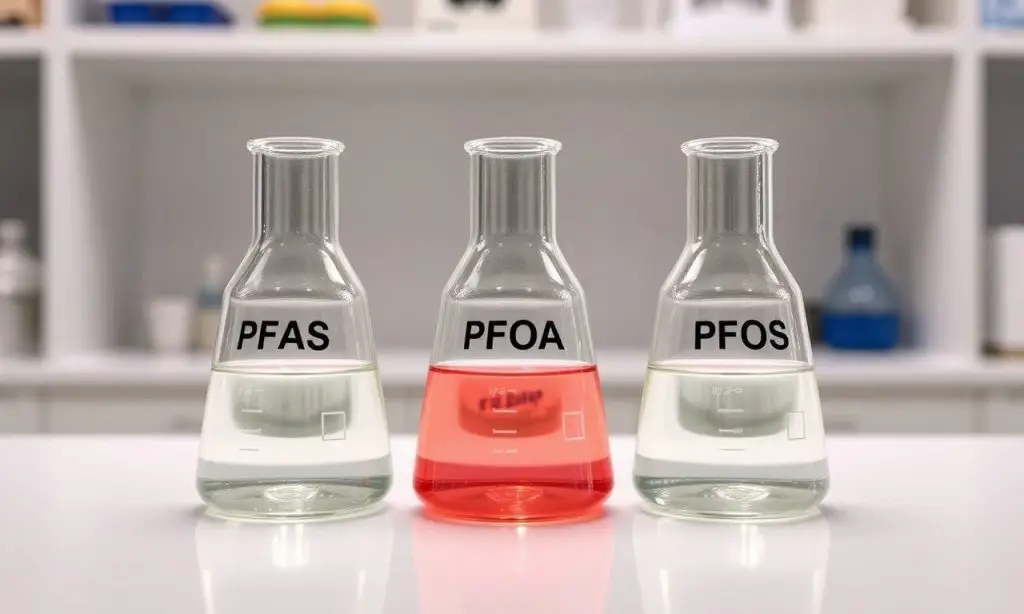
Navigating the Chemical Alphabet Soup
If you have spent any time researching “forever chemicals,” you have likely run into a confusing sea of acronyms. From news reports to water quality statements, terms like PFAS, PFOA, and PFOS are used frequently, but they are rarely explained in detail. To protect your family, it is crucial to understand that these aren’t just redundant names for the same thing. There is a hierarchy to this “alphabet soup,” and understanding the differences between these substances can help you make better decisions about the water filters you buy and the products you allow into your home. The first thing to understand is that PFAS is not a single chemical, but a massive family of thousands. To get started, you can explore what are pfas at a foundational level.
PFAS (Per- and Polyfluoroalkyl Substances) is the “umbrella” term. Imagine it as a large family tree with thousands of individual members. All members of this family share a common trait: an incredibly strong bond between carbon and fluorine. However, they differ in the length of their carbon chains and the specific atomic groups attached to them. Within this massive family of over 12,000 chemicals, two specific members have gained the most notoriety: PFOA and PFOS. These are the “long-chain” variants that were used most heavily in the 20th century. According to the EPA, while many of these have been phased out, their legacy remains a major concern for global health.
Breaking Down PFOA: The Teflon Connection
PFOA stands for Perfluorooctanoic acid. Historically, this chemical was the primary processing aid used to manufacture fluoropolymers, with its most famous application being Teflon. For decades, PFOA was essential for making non-stick pans, but it was also used in industrial lubricants and sealants. The problem with PFOA is that it is remarkably persistent and bioaccumulative. Once it enters the human body, it stays there for a very long time, binding to blood proteins and circulating through the liver and kidneys. This long residence time is what makes health exposure to PFOA so dangerous. Extensive scientific studies revealed that PFOA exposure was linked to high cholesterol, thyroid disease, and certain cancers.
This led to a major phase-out in the United States, where manufacturers agreed to eliminate the chemical. However, because it is a “forever chemical,” PFOA is still found in the drinking water of millions of Americans today due to historical industrial discharge. This persistent presence is a key driver of modern water contamination issues discovered in virtually every state. Research from the CDC (ATSDR) has shown that high levels of certain PFAS can affect the immune system. Identifying where pfas come from in these contexts has led to massive nationwide testing programs.
Breaking Down PFOS: The Fabric Protector
PFOS stands for Perfluorooctanesulfonic acid. While PFOA was mostly used for non-stick surfaces, PFOS was the star of the fabric and carpet world. It was the key ingredient in stain repellents for decades. It was also used extensively in Aqueous Film-Forming Foam (AFFF)—the specialized foam used to fight jet fuel fires at military bases and airports. PFOS is particularly effective at repelling both water and oil, making it a dream for textile manufacturers but a nightmare for environmental toxicologists. Like PFOA, PFOS is extremely resistant to degradation. Studies have shown that PFOS exposure can interfere with immune system function and has been linked to developmental issues in children.
Because of these risks, production was voluntarily phased out by major manufacturers in the early 2000s. However, PFOS remains highly prevalent in the soil and groundwater near military installations and airports where firefighting training took place. For many families, identifying pfas in products that were manufactured before these phase-outs is an important step in purging these legacy chemicals from their homes. Learning about reducing pfas at home by installing pointing-of-entry filtration systems is becoming common. Experts at the NIEHS continue to lead the charge in identifying these newer threats.
The Future of Chemical Management
As PFOA and PFOS were phased out, the chemical industry replaced them with “short-chain” PFAS alternatives, such as GenX. The industry’s argument was that because these molecules have shorter carbon chains, they leave the body faster. However, newer research suggests they may be just as persistent in the environment and could carry similar health risks. This has led to a major scientific debate about whether we should be regulating these chemicals as an entire class. To truly protect yourself, look for products labeled as “PFAS-Free.” Staying updated with research from high-authority sites like NIH research portals is the best way to keep up with this evolving alphabet soup. By staying informed, we can navigate the alphabet soup and move toward a cleaner future.